All posts by Matthew Makrinos

COVID-19 and the SAT: Will the Fallout Sideline the Class of 2021? Part 2 of 3

Coronavirus Standardized Testing SAT ACT

Covid-19 and standardized testing: Second Scenario

In the second scenario, if state clearance is not in place in time to permit the administering of the August SAT, it is entirely possible that colleges will not want their application season contingent upon students’ opportunity to take the SAT and ACT. In this case, colleges will waive standardized testing for that admission cycle, essentially going Test Optional nationwide for the class of 2021. In place of the SAT/ACT, the colleges will impose some other requirements such as a graded writing sample or extra essays. Either way, there will be additional hoops to jump through. Graduate school programs are already setting precedent for this scenario with universities poised to announce their waiving of GRE and GMAT scores for admission for Masters and MBA programs.

The impact of this scenario could, of course, be devastating for the College Board and ACT Inc.. Once we get used to something, we are likely to stick with it, and both testing bureaus could find their positions precarious for future admission cycles.  In an effort to avoid this, the testing bureaus may be driven to a third scenario.

Marlee Napurano, BA Yale University, is Co-founder of WaveLength tutoring and test prep, a test preparation and college consulting company in its 19th year serving Monmouth and Ocean counties.

COVID-19 and the SAT: Will the Fallout Sideline the Class of 2021? Part 3 of 3

COVID-19 college admissions standardized testing SAT ACT

Covid-19 and standardized testing: Third Scenario

The impact of Covid-19 is of course, devastating for the College Board and ACT Inc.. Once we get used to something, we are likely to stick with it, and both testing bureaus could find their positions precarious for future admission cycles.  In an effort to avoid this, the testing bureaus may be driven to a third scenario, in which they hustle to roll out the tech to administer these exams to individual students at home online. We have seen this technology on many platforms currently used in online college and graduate level courses, where testing is performed  in a room at home, but with a WebCam monitoring for a remote proctor and strict time constraints for completion all of which ensure the test taker is not collaborating with anyone else or using outside materials. It may be hard to imagine the manpower required to administer the SAT to thousands of students all in separate locations, but the alternative for the College Board could be the untimely death of the SAT, and they are certain to go down swinging.

So what should you take away from all this if you have a high school junior? The college admission process is sound, fair, and pre-dates the SAT by two-hundred years. American colleges are no strangers to surviving crisis: Yale University, for example, closed its campus for two whole years during the American Revolution (yep, that’s how long they’ve been around). Colleges will not persecute our kids for the Covid-19 damage done to admission test scheduling. They are on the forefront of efforts to preserve normalcy during social distancing, delivering admission decisions last week as usual and brainstorming creative ways to celebrate the achievements of seniors in lieu of traditional commencement ceremonies. This season’s college admission process will be different from the norm, but no more difficult. The hardest part will probably be getting your refund for your cancelled SAT.

Marlee Napurano, BA Yale University, is Co-founder of WaveLength tutoring and test prep, a test preparation and college consulting company in its 19th year serving Monmouth and Ocean counties.

Low SAT Math scores for good Math students

Why are my SAT Math scores so low even though I am a good Math student?

High school math courses rely heavily upon homework. It is doled out daily, done mechanically by rote, and very few, if any of the problems are word problems. This is why so many students fear Physics and Chemistry classes. They may not realize it, but those classes and life after school are word problem based. The most common misconception about the SAT Math section is that it is primarily about Math. It is not. It is roughly 90% word problems, and as such, it is primarily a reading comprehension section. Math is secondary.

Chemistry and Physics should be easy classes because they describe the world as we experience it. We have so much first hand knowledge from our first breath to our drivers’ test, that physical sciences ought to be intuitive. In contrast, analyzing the poetry of Walt Whitman, learning a foreign language, or writing an essay about democracy and the helots of ancient Greece should be far more difficult than understanding gravity, friction, or acidity.

The inherent difficulty is in the words. Our Math and Science teachers take for granted that high school students know how to read a word problem. Teachers lack the time to address this critical step because they must teach new formulas and concepts in order to give their students the requisite knowledge they need to pass their impending quizzes, tests, and exams.

Students learn to read narratives at an early age. This is a different skill than reading a word problem. Word problems don’t have a back story or character development or even a denouement. The plot never thickens because it never exists.

Word problems are a set of instructions like a manual that tells us how to assemble a doll house. Insert tab A into slot B. Check! Onto the next instruction. Ultimately we assemble information into equations.

I have developed a method for reading word problems once to conclude with the correct answer. This is vital, because if a student has to read a word problem two, three, even four times before answering, they are essentially taking 90% of the test as many times. They will not finish the section in time. It is also likely that they won’t be sure if they are answering the question correctly or even understand the question being asked.

I would love to tell you more about how I teach this technique and what it entails, but it is so simple that every student learns it well and any teacher could teach it. I am sure you aren’t the only one reading our blog.

What I can tell you is that vocabulary plays a part and I have developed a list of SAT Math vocabulary that is complete and concise and all of it is found both in the SAT and the Skinny, WaveLength’s SAT study Guide.

After students learn my word problem method they have far more time to take the test and actually think about the Math. This relieves stress, minimizes careless errors and mental fatigue, and ultimately raises SAT Math scores to reflect or surpass school Math grades. There is an added bonus to all of this. Student Science grades will inevitably rise with out extra studying.

Read more about the ripple effect of our lessons and programs on our website under, Testimonials. Or for more details about our Math vocabulary and word problem method, Contact Us. Read carefully and keep practicing!

Here is an article that I happen to find fascinating: One Key Difference Between Kids Who Excel at Math and Those Who Don’t


Guess or Skip on an SAT Subject Test?

Guess or Skip? How and where we invest our time directly affects our SAT subject test scores.

Time is the one resource we are given and we must make the most of it. If there were no time limit, everyone would score higher in every section. It would be way easier to think carefully with out the duress of the clock. It is critical to use the limited time we are given wisely.

SAT subject tests start with the easiest questions and gradually become more difficult until the hardest questions at the end of the section.

A correct answer is worth the same 1 raw point whether it is an easy, medium, or hard question. That is why it is important to slow down and make sure you score on questions you know how to do. Do not waste time on hard questions. You can still get a great score with out them. Easy questions have best rate of return for the relatively small amount of time it takes to do them. There is a limited number of easy questions, so it is important to recognize them as an opportunity to build a strong score.

Scoring on a SAT subject test is similar to earning $100 for completing a quick and easy task or a difficult time consuming task. If either task is done wrong the penalty is $25. The choice is clear. Slow down and make sure you get all the easy $100 opportunities with out owing $25 for your efforts. With the remaining time, decide which of the harder tasks you can complete and don’t worry about the ones you don’t get to. There is no reward for completing a whole section, only for accumulating as many raw points with out giving any back. The SAT Math section has 54 total questions. If I skip the harder half of each section and use my extra time to focus on the easier first half of each section, I essentially have twice the time to execute the first half. Slowing down and focusing on the first half of the test is the best way to get them all right. By skipping the harder second half I did not give back any of the points I earned. My raw score is a 27 for the Math level I. This is about a 600 scaled Math score. Not bad for only doing half the test.

Once I know that I am not making any silly mistakes, I begin to take on more of the test. My next goal would be ⅔ of each section, then ¾ and so on. Never attempt more questions until you are sure you are not needlessly giving points away.
It is best to get two or less questions wrong…

A total of two wrong on the multiple choice in any of the three sections on the SAT means that a ½ a raw point will be subtracted from the raw score. For example, a raw score of a 30 would then become a 29.5. Raw scores are rounded to whole numbers. This means a 29.5 becomes a 30 and no points were lost. If three mistakes were made the 30 would become a 29.25 which would then be rounded down to a 29.

When skipping problems on an SAT subject test , mark them on the test with a symbol that let’s you know whether you want to attempt it later with your remaining time. That way you don’t have to waste time rereading every skipped problem. I like to use a star to revisit a problem and a question mark to avoid a problem. I know that feeling good is important to performing well. I do not think, “I should know how to do that” when I skip a problem. Instead, I think, “Glad I caught that giant waste of time and effort early. Now I can use this extra time to make sure I get easier problems right.” Be your own biggest fan and keep practicing. Contact WaveLength if you want to learn more about this and other SAT subject test strategies. Keep practicing and good luck!

ACT or SAT?

Should I take the ACT or the SAT?

It’s a question I am asked more and more frequently since almost every university and college now accepts either test for their admissions process. There is no easy way to answer this with out knowing many different things. In an effort to find the best answer, I respond with the following questions:

Have you taken the PLAN and the PSAT?

If not, have you taken both a real (not third party) SAT and ACT and scored them?

If so, have you compared the two test scores by percentile?

An apples to apples comparison is hard enough since the scores are scaled differently and made even more difficult because the sections of the two tests only roughly correspond. Here is a useful link to compare SAT and ACT scores

The SAT subject tests also deserve serious consideration.

Make a list of ten to twelve schools that you want to apply to. It should include, reach schools, 50/50 schools, and safety schools. Find out what all of their unique admissions requirements are. Do all or some of the schools you are applying to require SAT subject tests?

Most schools accept the ACT in lieu of SAT subjects tests. It may seem like far less work to take the ACT instead of the SAT and two or three one hour SAT subject tests but this may not be the wisest choice. The College Board offers eighteen different Subject Tests, many of which are foreign language tests. If you are multi-lingual this is a great place to shine.

Choosing the subjects in which you are tested presents a rare chance to show off your knowledge and put up some flashy standardized test scores. If you are going to be taking an AP exam in a given subject it would be smart to take the corresponding SAT subject test. I recommend taking SAT subject tests both Sophomore and Junior year on the date offered closest to final exams. This way your studying is synergistic. Why not kill two birds with one stone?

While it is en vogue to take the ACT, there is no advantage in doing so unless your PLAN scores are significantly higher than your PSAT scores. This is because the SAT requires far less knowledge and more test strategy than the ACT. This means that knowing how the SAT is graded and knowing whether to guess or skip can drastically change your score. It is something that anyone can learn. In contrast, knowing Trigonometry and the rules of logarithms will raise ACT scores, but will take far longer to master.

In addition, the SAT is the most studied test in the world, as such, it is more predictable than the ACT. This means that tutoring in and studying for the SAT usually leads to greater score improvements in every section of the test. ACT scores also improve with tutelage and study, but not as dramatically.

Which is right for you? Take a test in each and compare your results. Only if you score significantly higher by percentage in the ACT do I recommend taking it over the SAT. If you are favored by the ACT and decide to take it, you should still seriously consider taking two to three SAT subject tests in your very best subjects. Let your light shine!

Whatever you decide, decide on one test and prepare for it. Many parents register their students to take multiple ACTs and SATs. This is overwhelming for any Junior and generally a losing strategy. It is best to pick one and focus. I hope you find this perspective helpful. Contact us if you have any further questions and good luck.

Scaled SAT Math scores and raw scores

Understanding your SAT Math Score and how it is derived is critical to scoring high.

When I began playing organized soccer I caught the very first ball kicked to me. I thought I did well and was confused when my coach yelled at me and the opponents got possession of the ball and a free kick. Catching the ball was natural to me, but not a great strategy for a fullback in soccer. Likewise,some test strategies that work well in school back-fire on the SAT because the SAT has a different set of rules. It is difficult to win with out knowing these rules.

The scaled score on the SAT is the final score we receive.

This score is curved and ranges between 200 and 800 for each section of the test. 500 is the national average (50th percentile) for a specific test section and date nationally. The scores that we see are derived from a raw score. The average of the raw scores is assigned a 500. You cannot score below a 200.

The SAT raw score determines the final scaled score.

As such, it is the score that you should focus on. It is calculated by giving 1 raw point for each correct answer and subtracting ¼ raw point for each wrong answer on every multiple choice question. No points are lost in the Student Produced open-ended section of the Math, so it is best to guess if you don’t know the answer in this section. Do not guess on the Multiple Choice questions unless you can eliminate three of the choices because they are definitely wrong. Otherwise, guessing leads to lower scores.

In school, if an answer is blank, it is wrong. So it is better to guess than to leave an answer blank. While this is a good strategy in school it is a bad strategy for the SAT. It is better to leave a blank and not give away fractional raw points. After all, there is an 80% chance that a guess is wrong.

This means that a guess is far more likely to hurt your score than to help it. Don’t ever guess out of five multiple choices and keep practicing. Questions? Contact WaveLength and we will be happy to answer.

Computer based practice tests for the SAT and ACT exams

Are computer based practice tests good training for the SAT?

I’m about to answer this question with another question: Do you still need to bring two No. 2 pencils to the SAT?

The SAT is still a paper test. We have a test booklet in front of us and we use it, crossing out eliminated answer choices, outlining the essay, labeling angles, etc. We also have to fill in a little, annoying bubble for each question on the answer sheet with our infamous No. 2 pencil. And even though most of you have been able to color inside the lines for quite a few years now (good job with that, by the way), many of you will still manage to mess up those bubbles, like everyone’s nightmare of skipping question #8 but forgetting to leave the bubble line blank for #8 and ending up with the rest of your section shifted up one row of bubbles.

So until the day the SAT changes to a computer based test, your practice tests should be on paper. Simulate testing conditions for yourself: wake up early on a Saturday morning, eat breakfast, and sit down to a full length paper practice SAT so you get used to making 8 am feel like noon on test day. That paper practice test will simulate the layout of the real SAT where the computer test will not, and being used to layout is important! For example, we approach easy, medium, and hard Sentence Completions with different mindsets, so determining the difficulty level of questions is important. In a Critical Reading section of the real SAT, the Sentence Completions are always all on one page together in 2 columns; at a glance we can see how many easy Sentence Completions we have before us because whatever falls in the left-hand column is an easy question. Getting yourself used to the real SAT layout is important for pacing and skipping across all sections, and this contextual layout is totally left out of computer practice tests.

Another benefit of a paper practice test is that you score it yourself. What may at first seem like a nuisance is actually an important lesson. Scoring the test yourself is a backstage pass to the grading and conversion from raw score to scaled score on the SAT. You’ll also get a feel for the value of getting even just one more right and you’ll directly observe the benefits of skipping more to keep your number wrong low or getting it down to two and blind guessing. A computer generated score leaves you out of that whole important process.

So go get yourself a good old, low-tech retired SAT from your guidance counselor or the College Board blue book, a four hour block of time, and, of course, a No. 2 pencil. If that practice test is not on paper, it’s just not like the real thing.

Beware The Hundred Point Guarantee on the SAT

Beware of the 100 point guarantee.
SAT scores are curved and not all problems are worth the same amount in the final scaled score even though they are worth the same in the raw score.

Imagine taking a test with 10 questions at school. If you get one wrong your grade is a 90% and if you get 9 wrong your grade is a 10%. It does not matter where you score with respect to the class average. Every problem is worth the same 10% and so all of the class scores are linear. This is NOT how the SAT works.

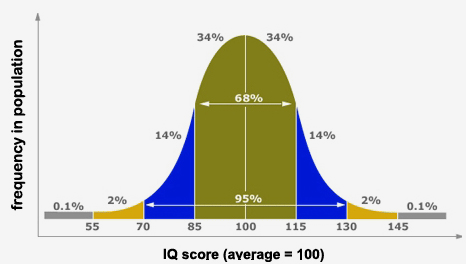
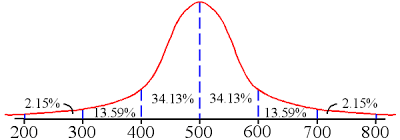
I am going to show you how moving 100 points in the Math section is radically different depending on the where student scores on a bell curve (similar to the IQ bell curve) by comparing raw and scaled scores.

IQ-Bell-Curve

Below is a list of raw Math scores and their corresponding scaled scores. Please note how the Difference in Raw Points changes to gain another 100 points along the way from a 200 to an 800. Remember raw scores are calculated by giving 1 raw point for each correct answer and subtracting ¼ raw point for each wrong answer on every multiple choice question. For more on Raw scores please reference Scaled SAT Math scores and Raw Scores.


Math Scaled Scores


Math Raw Score


Difference in Raw Points


200

300

5

5

400

13

8

500

25

12

600

37

12

700

48

11

800

53-54

5-6

While the requisite raw score for a given scaled score may change slightly on any given date due to the curve, it does not change much since the sample group of students taking the test is so large.

According to ETS, over 2.5 million students take the test across seven different test dates annually.

For simplicity, we can assume an even distribution of test takers (which of course is not the case) to find that 357,000 students take the test each time it is administered. That is a huge sample group, the type that assures miniscule deviation and that any insurance underwriter would covet.

SAT scores bell curve

So now that we have gotten through all of the rough numbers, what do they mean? Simply put, the further away from the national average score of 500, the fewer raw points it takes to drastically change a scaled score. 


This is important to know so you can understand how far away you actually are from your goals. Climbing from a 400 to a 600 is a lot of work. 24 more raw points is a considerable task when there are only 54 available raw points in the Math section. This is much harder than getting from 600 to an 800, only 16 raw points away. It makes me wonder how any company can blindly guarantee 100 point gain in a subject with out knowing  where a student sits on the curve. But seeing what most companies offer as compensation is laughable and somewhat insulting. Please do your research. Ask questions before you commit your time and resources and beware of gimmicks and imitators. 

Scaled SAT Math scores and raw scores

Understanding your SAT Math Score and how it is derived is critical to scoring high.

When I began playing organized soccer I caught the very first ball kicked to me. I thought I did well and was confused when my coach yelled at me and the opponents got possession of the ball and a free kick. Catching the ball was natural to me, but not a great strategy for a fullback in soccer. Likewise,some test strategies that work well in school back-fire on the SAT because the SAT has a different set of rules. It is difficult to win with out knowing these rules.

The scaled score on the SAT is the final score we receive.

This score is curved and ranges between 200 and 800 for each section of the test. 500 is the national average (50th percentile) for a specific test section and date nationally. The scores that we see are derived from a raw score. The average of the raw scores is assigned a 500.< You cannot score below a 200. The SAT raw score determines the final scaled score.

As such, it is the score that you should focus on. It is calculated by giving 1 raw point for each correct answer and subtracting ¼ raw point for each wrong answer on every multiple choice question. No points are lost in the Student Produced open-ended section of the Math, so it is best to guess if you don’t know the answer in this section. Do not guess on the Multiple Choice questions unless you can eliminate three of the choices because they are definitely wrong. Otherwise, guessing leads to lower scores.

In school, if an answer is blank, it is wrong. So it is better to guess than to leave an answer blank. While this is a good strategy in school it is a bad strategy for the SAT. It is better to leave a blank and not give away fractional raw points. After all, there is an 80% chance that a guess is wrong.

This means that a guess is far more likely to hurt your score than to help it. Don’t ever guess out of five multiple choices and keep practicing. Questions? Contact WaveLength and we will be happy to answer.